Design Your Own
Bring us a drawing.
Or just an idea.
On most fabricators' websites, custom means picking from six patterns. Here it means what it says. Your gate is drawn from nothing, for your opening, around something that belongs to you: a name, a deity, a tree, a scene, a company mark. Then cut from solid steel on our own plasma table, from the file we drew.
You don't need to arrive with a design. Most people arrive with a feeling and a photograph of a gap in a wall. That is genuinely enough to start.
- The drawing is includedNot a separate design fee
- Two rounds of changesBefore anything is cut
- You approve firstNo steel is touched until you do
The part nobody explains
Custom costs far
less here than
you'd expect.
In a shop that cuts by hand, ornament is labour. Every curve is somebody's afternoon. So a plain gate is cheap, a decorated one is expensive, and over time custom becomes a polite word for costly.
We work the other way round. The design is drawn as a file and the plasma table follows that file. A lotus and a straight bar are the same instruction to the machine — it simply moves differently.
That doesn't make detail free. More detail means more time on the table, more consumables and more finishing by hand once the panel comes off it, so an intricate piece does cost more than a plain one. But it costs a fraction of what the same piece would cost anywhere that has to cut it by hand — and we don't do that is never the answer you'll get here.
What actually moves your price
- The size of the opening
- The gauge of the steel
- How much detail is in the design
- The coating you choose
We go through all four with you at quote stage, in writing, before anything is agreed.
Where designs come from
You don't need to be a designer.
Nearly every piece we've cut started as one of these six. Find the one that sounds like you — that's the whole of what you need to bring.
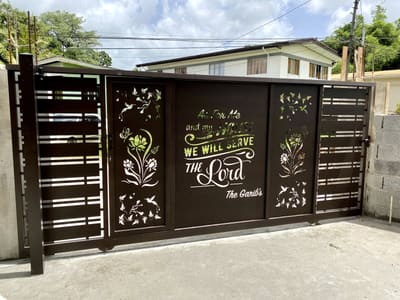
Your name
A surname across the top rail. Initials worked into a monogram. A verse that means something in your house.
Heraldic & Monogram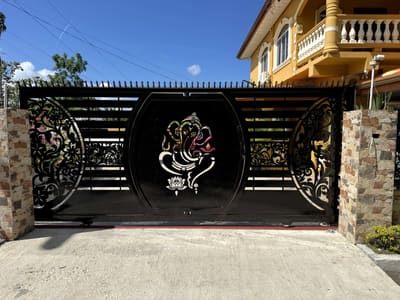
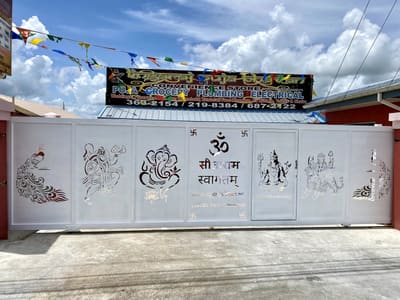
Your faith
Ganesha, Om, Hanuman, a cross, a lotus. Cut at the scale it deserves and set into the gate, not stuck on afterwards.
Cultural & Devotional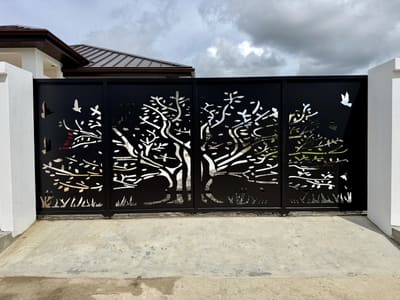
Something living
The tree outside your window. Birds, palms, monstera. Butterflies rising along an entire fence line.
Nature & Botanical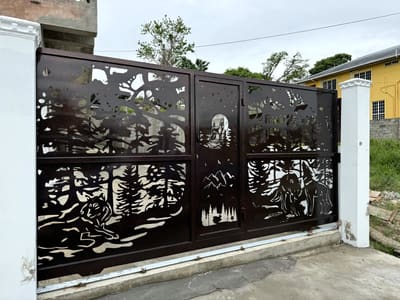
A story
A forest at night. A wolf under a moon. A horse hidden in the branches. Scenes that run across every panel instead of repeating.
Narrative Scene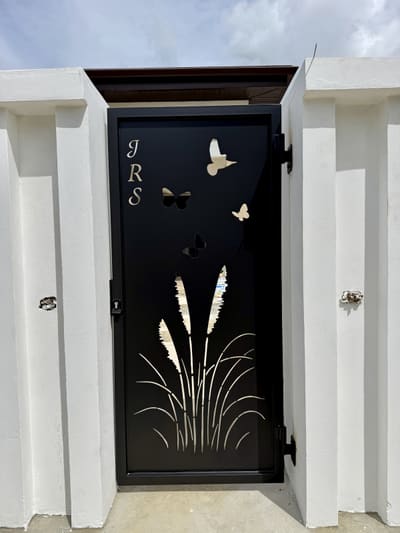
A mark or a logo
A monogram, a crest, your company mark on the frontage of your premises. If it exists as a drawing, it can exist in steel.
Heraldic & Monogram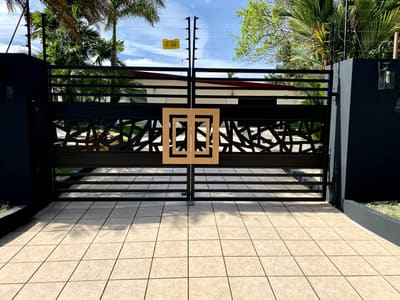
A pattern you liked
You saw something somewhere and took a photograph of it. Send us the photo and we'll draw from it — your version, at your dimensions.
Modern GeometricHow a design happens
Nothing is cut until you say yes.
-
01
Start with a sentence
A sentence is enough. A tree, but not too busy. My mother's name. Something like the gate on the corner, but ours. A photo of the opening helps more than anything else you can send.
-
02
We measure and draw
We measure the opening properly, then draw your design at its real dimensions. There's no separate design fee — drawing your gate is part of quoting for it.
-
03
You approve the drawing
You see your gate, at your size, before any steel is touched. Two rounds of changes are included, so you are never choosing between speaking up and holding up your own job.
-
04
We cut, coat and install
Cut on our own CNC plasma table, welded up, finished in powder coat and installed. From that point on it follows exactly what you approved.
What to send us
Any one of these is a starting point. You don't need all of them, and you don't need the first one to be good.
- A photo of the opening. The single most useful thing there is.
- A sketch on paper. It doesn't have to be well drawn. It has to be yours.
- A photo of something you liked. Anywhere you saw it.
- A drawing or logo file. If your architect or designer has given you one, send it and we'll confirm we can work from that format before you count on it.
- Or a sentence. Most jobs start as one.
Honest guidance
What works in steel,
and what doesn't.
A gate is not a print. Knowing how steel behaves before the drawing is finished is what stops a design being a disappointment once it's a few hundred kilos of powder-coated metal bolted to your wall.
Bold shapes hold. Hairlines don't.
There's a minimum width a cut can be before the steel left around it stops being strong enough to stand up. Confident shapes live comfortably above that limit. Spidery detail doesn't, and it's better to know at the drawing than at the table.
Everything has to hold on to something.
A cut panel is one continuous piece of steel. The centre of a letter O, the eye of a bird, the island inside a leaf — anything fully enclosed has to be bridged back to the panel or it simply drops out. Those bridges are part of the drawing, and done well you stop seeing them.
A photograph becomes a drawing.
Faces, animals and photographs translate into bold line art rather than photographs. That isn't a compromise — it's exactly what makes them read from the road instead of dissolving into grey.
Detail should suit the distance.
A driveway gate is mostly seen from a moving car, so it wants weight and clear silhouette. A burglar-proof panel, an interior screen or a pedestrian gate is seen from three feet away and can carry many times the detail.
Solid areas add weight and catch wind.
The denser the design, the heavier the leaf and the more wind it takes on an exposed frontage. That affects hinges, posts and how a sliding gate runs — all of which we'd rather raise while it's still a drawing.
None of these are refusals. They're the things we'd tell you across a table, and they're the reason the drawing stage exists at all.
From file to steel
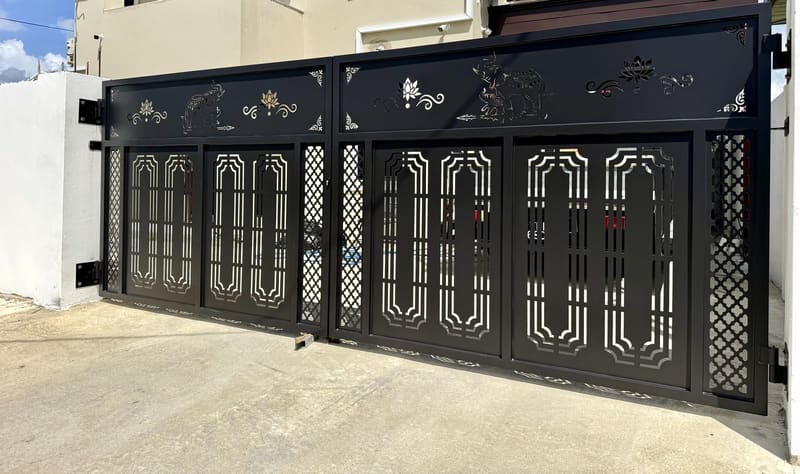
Every one of these was a file first.
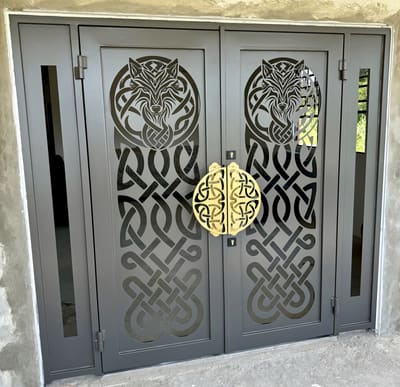
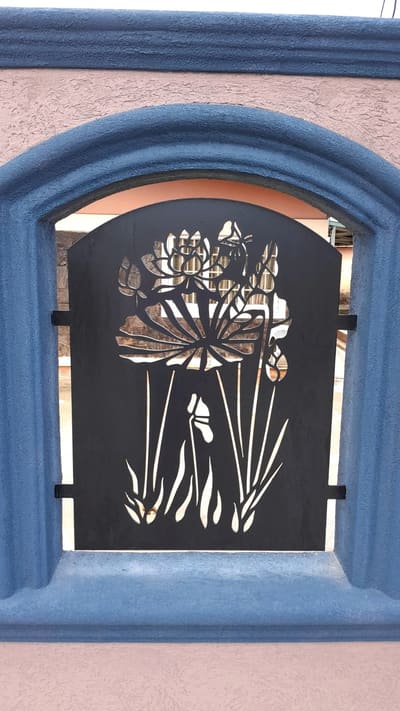
Before it was a gate, it was a drawing on a screen — full size, to the millimetre, built around the real measurements of your opening. The table then cuts precisely that. It's why a design this involved is possible at all, and why what arrives at your house is what you approved rather than an interpretation of it.
Selected work
Six that were somebody's idea first.
None of these existed before the customer described it. Follow any of them into the catalog to see the rest of that style.
Start here
Tell us the idea.
You don't need a design, a drawing, or the right words for it. Tell us roughly what it should be about and roughly how wide the opening is, and we'll come back with ideas and a price in writing.
Prefer to message? WhatsApp 769-1035. Though for a design brief the quote form is better — it keeps a written record of exactly what was asked for, for both of us.